Showing posts with label random. Show all posts

Monday, June 08, 2015

An Excellent Experimental Framework.

Recently I have been watching through a lecture series on Deep Learning for NLP.  It's a topic that I have long been interested in, and I'm learning lots as I go along.  It has been a welcome relief from thesis writing.

In the first 15 minutes of the fifth lecture, Richard Socher outlines the steps that his students should take for their class projects. I wanted to reproduce them here as I think they are really useful for anybody who is performing experiments in Machine Learning with Natural Language Processing. Although the steps are aimed at a class project in a university course, I think they are applicable to anybody starting out in NLP, and helpful as a reminder to all who are established.  I had to figure these steps out myself as I went along, so it is very encouraging to see them being taught to students.  The eight steps (with my notes) are as follows. Or, if you'd prefer, scroll to the bottom of the page and watch the first fifteen minutes of the video there.

Step 1 - Define Task

Before you make a start you need to know what your task is going to be.  Read the literature. Read the literature's background literature. Email researchers who you find interesting and ask about their work. Skype them if they'll let you.  Make sure you know clearly what your task is.

Step 2 - Define Dataset

There are a lot of ready made datasets that you can go and grab.  You'll already know what these are if you've read the literature suitably.  If there is no suitable dataset for your task, then you will need to build one.  This is a whole other area and can lead to an entire paper in itself.

Step 3 - Define Your Metric

How are you going to evaluate your results?  Is it the right way? Often your dataset will naturally lead you to one evaluation metric.  If not, look at what other people are using. Try to understand a metric before using it.  This will speed up your analysis later.

Step 4 - Split Your Dataset

Training, Validation, Testing. Make sure you have these three partitions.  If you're feeling really confident, don't look at the testing data until you absolutely have to, then run your algorithm as few times as possible. Once should be enough.  The training set is the meat and bones of your algorithm's learning and the validation set is for fiddling with parameters.  But be careful, the more you fiddle with parameters, the more likely you become to over fit to your validation set.

Step 5 - Establish a Baseline

What would be a sensible baseline?  Random decisions? Common sense judgements?  Maximum class? A competitor's algorithm?  Think carefully about this.  How will your model be different from the baseline?

Step 6 - Implement an Existing (Neural Net) Model

Neural Net is in brackets because it is specific to the course in the video.  Go find an interesting ML model and apply it.  I have started to use WEKA for all my ML experiments and I find it really efficient.

Step 7 - Always Be Close to Your Data

Go look at your data.  If you're tagging something look at what's been tagged.  If you're generating something read the resultant text.  Analyse the data. Make metadata. Analyse the metadata.  Repeat. Where do things go wrong?  If you have a pipeline, are some modules better than others? Are errors propagating through?

Step 8 - Try Different Models

Play around a bit.  Maybe another model will perform much better or worse than the first one you try.  If you analyse the differences in performance, you might start to realise something interesting about your task.  I would recommend setting up a framework for your experiments, so as you can quickly change things around and re-run with different models / parameters.

Step 9 - Do Something New

 OK, this isn't a step in the video per se. But, it is the extension of the methodology.  Now that you have tried something, you can see where it was good and where it was bad.  Now is the time to figure out how to make it better.  Different models, different features, different ways of using features, are all good places to start.


The video is below and also accessible at this link:
https://www.youtube.com/watch?v=I2TfdXfSOfc

If you are interested in the topic then the course syllabus with all videos, and lecture notes is here:
http://cs224d.stanford.edu/syllabus.html



Thursday, January 15, 2015

September 2015

Thirty-Nine months ago, I started my PhD.  As I look back through logbooks, half written papers and the accumulated file lint that clutters my desktop, I wonder where that time has gone.  But this is no time for reflection.  From here on out, my eyes are set firmly on September 2015.  They must be, if I hope to finish my PhD.

Over the coming nine months I hope to achieve all of the following goals:
  1. Finish off some experiments using machine learning to rank substitutions in different contexts. 
  2. Write up and submit this work to the main track at ACL-IJCNLP 2015.
  3. Design and implement an experiment looking at the effects of simplification for people with aphasia.
  4. Compose my thesis.
  5. Find a job.

All in all, I think that this is manageable.  I would really like to go to ACL this year, but my fate will be left to the hands of the reviewers.  I haven't formally started writing my thesis yet, but I do have lots of material written up, so I intend to start with this and work from that point.  The aphasia experiments will be interesting, but I'll write more about them at a later point.  Lots to do, so best get started.

Wednesday, October 29, 2014

Why Lexical?

In this post I will put forward my arguments for picking lexical simplification as a PhD topic.  I'm certainly going to face that dangerous 'why' question when writing up my thesis, not to mention in the viva. I figure that if I commit my reasoning to page now, then I can come back to it at a later date. To convince myself, if not others.

The question of 'why lexical?' needs addressing at two levels.  Firstly, why choose simplification given the wide scope of natural language processing applications to which I could have committed four years of my life?  Secondly, why lexical simplification given the wide range of simplification research out there?  I'll answer these in turn.

Why Simplification?


Let me start with a confession. I didn't start a PhD to study lexical simplification.  I didn't even come with natural language processing in mind.  About four years ago I was offered an opportunity to study at Manchester on the newly founded Centre for Doctoral Training (CDT).  One of the aspects of the CDT programme which appealed to me was the fact that students were not initially tied to a supervisor or research group. We were in effect free for our first six months to decide upon a group, supervisor and topic.

During the first six months, I took three masters modules.  Two on machine learning and one on digital biology.  Both fascinating fields, and both of which have ample opportunities for a PhD.  I spoke to the relevant people about these opportunities, but I just couldn't find something that inspired me.  Resigned to the fact that I may have to choose a topic and wait for the inspiration to come I started to focus on the machine learning research.

We had weekly seminars to acquaint us with the research in the school.  Each seminar was given by a different research group.  They varied in style and form - from the professor who brought in props to talk us through the history of hard drives to the professor who promised free cake every time their group had a major publication.  One week, it was the turn of the text mining group.  During the presentation the idea that text mining could be used to make difficult documents easier to understand was mentioned.  I took the bait, started reading papers, emailed my prospective supervisor and from there I was away.  The spark of inspiration drove me to develop my first experiments, which led to a literature review and an initial study on complex word identification.

Simplification is a great field to be working in.  I like that the research I'm doing could improve a user's quality of life. Ok, the technology isn't quite there yet, but the point of research is to reach out to the unattained. To do something that hasn't been done before. There are lots of opportunities in simplification. Lots of unexplored avenues.  I'm going to write a long future work section in my thesis (maybe a future post?) because there is a lot to say.

Why Lexical?


When I started looking into simplification back in 2011, there were three main avenues that I could discern from the literature.  Firstly, syntactic simplification - automated methods for splitting sentences, dealing with wh- phrases and the passive voice.  Secondly, lexical simplification - the automatic conversion of complex vocabulary into easy to understand words.  Finally, semantic simplification - taking the meaning into account and doing some processing based on this.  I grouped both lexical elaboration and statistical machine translation under this category, although I would probably now put elaboration under the lexical category.

I felt that my research would be best placed if it fell underneath one of those categories.  Although I could see viable research options in all of these, my background in machine learning and data mining was best suited for lexical simplification.  This was also around the time that the SemEval 2012 lexical simplification task was announced.  This task gave me an intial dataset, my background in AI gave me a set of techniques to apply.  From there I ran some initial experiments, implemented a basic system and started learning the complexities of the discipline.

It's strange to think that I'm writing about a decision I made several years ago.  I've tried to be as honest as I can remember in this post.  The PhD has not been a particularly easy road, but it has been a good one so far.

Tuesday, January 28, 2014

XKCD and simplification.

I have been an avid reader of the webcomic xkcd since my days as an undergrad.  If you've never heard of it, I would recommend you check it out, some of them are laugh-out-loud funny.  There are several comics that stick out as having a simplification theme.  I'm going to use this post to look at those comics through the lens of automatic simplification.  I'll try to explain what we can do with the current technology and what we just plain can't.

Simple

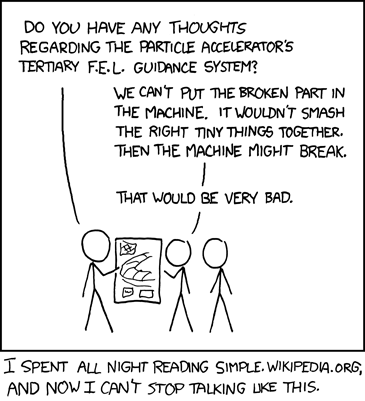
Particle accelerators are complex beasts.  I can empathise with the character who read so much simple Wikipedia that he can only talk in that way now.  One of the techniques we use in simplification is language modelling.  A mathematical model of sentences is trained which can be used to score new sentences to say how likely they are to have been produced by a language.  So for example:  "I went to the bank" might recieve a higher score than "I to the banking place did go".  As the latter sentence is poorly written.  An interesting factor of language models is that the scores they give rely heavily on the sentences which are used to train them.  So if you train a model using the text of the English Wikipedia you are likely to get very difficult to understand language.  If you train a model using the text of Simple Wikipedia, you are likely to get very simple sounding language, just like the second character in this comic.  A great paper which explains this further (without the xkcd references) is Kauchak (2013) (see the lexical simplification list).

Up Goer Five

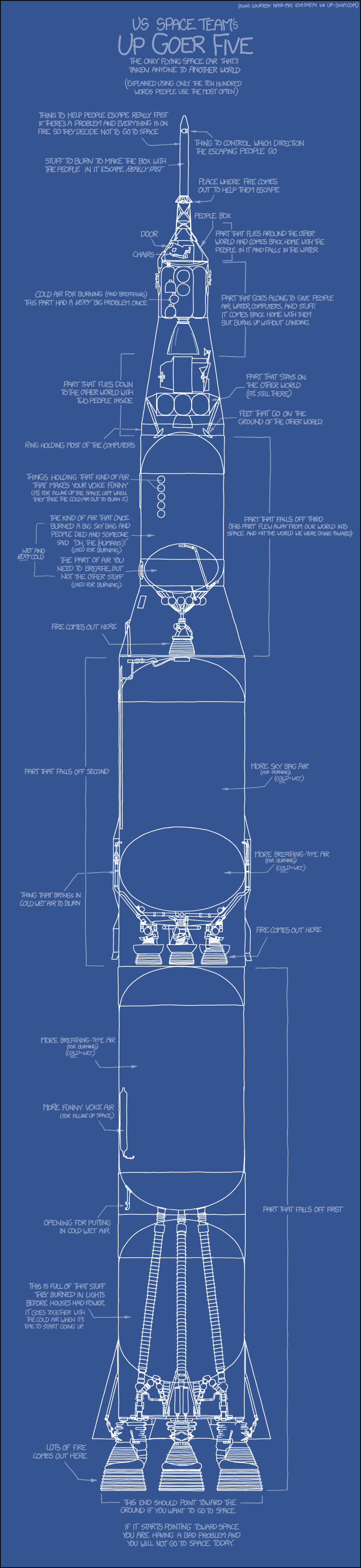
This next one is too long to put in this post - but it's worth a read.  The full comic is here: Up Goer Five (Or, right click on the image and open it in a new tab to view).

The comic presents a simplified blueprint of the Saturn V rocket.  The translator has been restricted to only the thousand most common words in the English language.  There is some question as to where the statistics for the 'thousand most common words' came from.  If it were taken from NASA technical rocket manuals then there may have needed to be little change!  We'll assume that it was taken from some comprehensive resource.  The best way of determining this with currently available resources would be to use the top ranked words in the Google Web1T corpus (Google counted a trillion words and recorded how often each one occurred.)

The style of translation in this comic is phenomenally difficult to achieve, even for humans.  You can try it for yourself at The Up-Goer Five text editor.  Most words have been substituted for simpler phrases, or explanations.  Some technical terms rely on outside knowledge - which actually has the effect of making the sentence more difficult to understand.  For example, one label reads: "This is full of that stuff they burned in lights before houses had power".  This is referring to kerosene, which is highly understandable if you know of kerosene but inapproachable if not.

It would be an interesting experiment to determine the lowest number of words required to be able to produce this kind of simplification without having to draw on inferred knowledge (such as the type of fuel lights once burned).  My guess is that you would need 10 - 20,000 before this became a reality.  It would be difficult to automatically produce text at this level of simplicity.  Explaining a concept requires a really deep understanding and background knowledge, which is difficult to emulate with a machine.

Winter


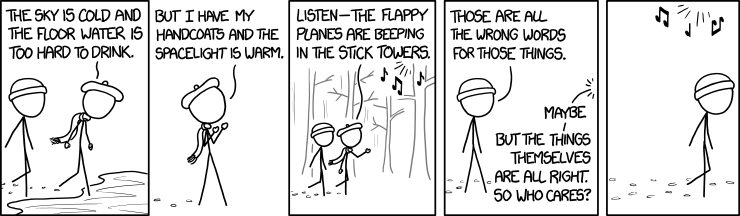
The above comic touches on an excellent point.  If the words we use are understandable, does it matter if they're not the correct words? Previously, I have written about lexical complexity noting that many factors affect how difficult we find a word.  The big factor that is played on here is context.  For example the term 'handcoats' in the second panel is understandable (as gloves) because we know from the first panel that 'the sky is cold'.  Handcoats is a word that you've probably never seen before, and out of context it would be difficult to get the meaning.  This highlights the importance of selecting words which fit the context of a sentence. If the correct context is chosen and a simple word fitting that context is used, then the understandability of a sentence will be dramatically increased.


Thursday, August 01, 2013

Randomising lines a very large file with java

I came across an interesting problem today.  I have some nice results from counting data and I wanted to see if the same results would appear if I randomised the underlying dataset.  The problem?  The dataset is a 17 Gigabyte file.

All the solutions I could find online required the file to be read into memory at some point.  Obviously, with my 8GB of RAM these were not acceptable solutions.  I needed a solution which would allow one line to be in memory at once and then to be discarded.

I reasoned that if I wrote the lines of the file into separate files, I could create some randomisation.  I also realised that the more files there were, the greater the randomisation.

Below is the java code I wrote, as well as a bash wrapper script. It takes a file and a numeric argument denoting how many files to write into.  It then  assigns each line at random to one of the files until it runs out of lines.  These files can then be concatenated together in  a post-processing step.  I think it's quite a neat solution.  I've commented the code for readability, so hopefully it will be reusable.  Of course this is not true randomisation as some ordering is preserved, however it should work for most purposes.

For my 17GB file it took 22 minutes to run, writing to 1000 files.  Needless to say that most of that time was taken up by I/O.


import java.io.PrintWriter;
import java.io.FileWriter;
import java.io.FileReader;
import java.io.BufferedReader;
import java.util.Random;

public class RandomiseLines
{
  public static void main(String [] args) throws Exception
  {
    if(args.length != 2)
    {
      System.out.println("Usage: java RandomiseLines <file> <No of Output Files>");
      System.exit(-1);
    }

    //the number of separate files to place lines into.
    final int FILENUM = Integer.parseInt(args[1]);

    //initialise the random number generator.
    final long SEED = 1;
    Random generator = new Random(SEED);

    //if seed isn't required, comment above and use:
    /*
      Random generator = new Random;
    */

    //initialise the file writers
    PrintWriter [] writers = new PrintWriter[FILENUM];
    for (int i = 0; i < FILENUM; i++)
     writers[i] = new PrintWriter(new FileWriter("out." + i + ".txt"));

    //read in the file
    int key;
    String line;
    BufferedReader in = new BufferedReader(new FileReader(args[0]));
    while((line = in.readLine()) != null)
    {

      //generate a random number between 0 and FILENUM - 1
      key = (int)Math.floor(FILENUM*generator.nextDouble());

      //write the line to the chosen file;
      writers[key].println(line);
    }//while

    //close IO
    in.close();
    for(int i = 0; i < FILENUM; i++)
     writers[i].close();
   
  }//main
}//class

The following shell script can be used as a wrapper to the programme.
#!/bin/bash

FileNum=10;

java RandomiseLines $1 $FileNum

echo "" > randomised.txt

for i in `seq 0 $(($FileNum -1))`; do
 cat out.$i.txt >> randomised.txt;
 rm out.$i.txt
done

exit