Showing posts with label complex words. Show all posts

Thursday, July 24, 2014

The Choices of a Simplification System

There are many choices to make when building an LS system. In my experience there are three big decisions to take: the target audience; the source documents; and the mode of presentation. Let's look at each of these in detail.

Target Audience


Firstly, you need a well defined group to aim your simplification at.  This group should have a clear style of language, documents written specifically for the group may be useful here.  They should all require a similar form of simplification, otherwise you will be writing several simplification systems.  The group shouldn't be too narrowly defined (e.g. Deaf children in the age range 8-11 with a below average reading age), as this will make it difficult to find test subjects.  It also shouldn't be too broadly defined, otherwise different simplification needs may be present.

Once you have a group to simplify documents for, you're ready to consider the next step.


Source Material


You must decide what type of text to simplify.  It's easy to assume that text is text and you can just build a general model, but in fact different genres have their own peculiarities and jargon.  Consider the difference between a set of news articles, Wikipedia entries and social media posts.  Each will be significantly different in composition than the last.  Of course, the text genre should be one which the target audience wants you to simplify!  That's why this step comes after selecting the target group.  It's also important at this point to check that nobody else has tried to simplify the type of documents that you're working with.


Mode of Presentation


There are, roughly speaking, three ways of presenting the simplifications to the end user.  Which one you choose depends upon factors such as the text itself, the requirements of the user and the reason behind the simplification. Each has advantages and disadvantages as outlined below:

Fully Automated


Substitutions are applied directly to the text where possible.  The user never sees the simplifications being made and so does not need to know that they are reading a simplified document.

Advantages:
  • User is presented with a simple document
  • Requires minimum work from author / user
  • Can be performed on the fly - e.g. whilst browsing the web / reading e-books / etc.
Disadvantages:
  • Errors in the simplification process cannot be recovered
  • Simplification may alter the meaning away from what the original author intended
  • Some words may not be simplified - leaving difficult terms to be seen by the user

Author Aid


The simplifications are presented to the author of the document, who chooses when and how to apply the simplifications.  In this case, the simplification acts similarly to a spell checker.

Advantages:
  • Author can make simplifications which retain their original intention
  • No chance of grammar mistakes - as the author has the final say of which words to use
Disadvantages:
  • Work must be simplified before being published
  • No guarantee that the author will apply the suggested simplifications

On Demand


The user has the option to look up simplifications if they find a word too difficult.  These simplifications are typically presented somewhere nearby on the screen.  For example, if a word is clicked on, the simplification may appear in a pop up box or in a dedicated area outside of the body of text.

Advantages:
  • User gets to see the original text
  • Helps language learning / recovery as the user can decide when they require simplification
Disadvantages:
  •  User may struggle if a text or portion of a text has a high density of difficult words
  • The user may be distracted by the simplifications, which divert their attention away from the text

Tuesday, January 28, 2014

XKCD and simplification.

I have been an avid reader of the webcomic xkcd since my days as an undergrad.  If you've never heard of it, I would recommend you check it out, some of them are laugh-out-loud funny.  There are several comics that stick out as having a simplification theme.  I'm going to use this post to look at those comics through the lens of automatic simplification.  I'll try to explain what we can do with the current technology and what we just plain can't.

Simple

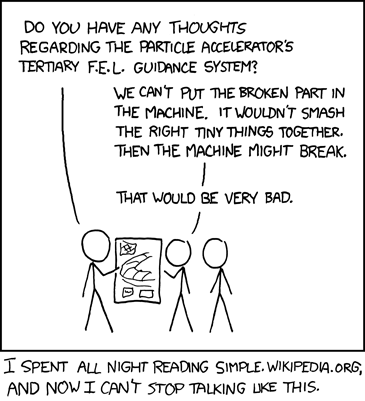
Particle accelerators are complex beasts.  I can empathise with the character who read so much simple Wikipedia that he can only talk in that way now.  One of the techniques we use in simplification is language modelling.  A mathematical model of sentences is trained which can be used to score new sentences to say how likely they are to have been produced by a language.  So for example:  "I went to the bank" might recieve a higher score than "I to the banking place did go".  As the latter sentence is poorly written.  An interesting factor of language models is that the scores they give rely heavily on the sentences which are used to train them.  So if you train a model using the text of the English Wikipedia you are likely to get very difficult to understand language.  If you train a model using the text of Simple Wikipedia, you are likely to get very simple sounding language, just like the second character in this comic.  A great paper which explains this further (without the xkcd references) is Kauchak (2013) (see the lexical simplification list).

Up Goer Five

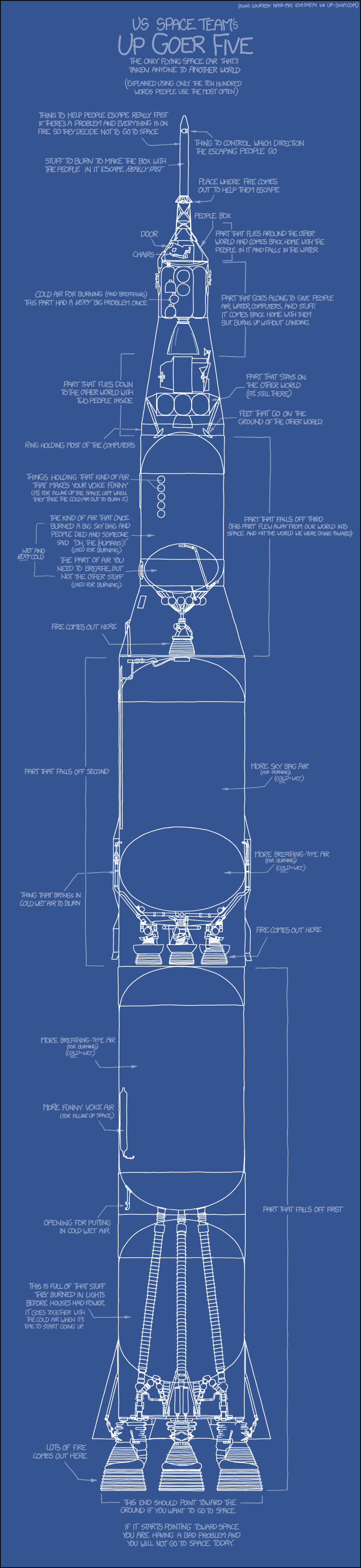
This next one is too long to put in this post - but it's worth a read.  The full comic is here: Up Goer Five (Or, right click on the image and open it in a new tab to view).

The comic presents a simplified blueprint of the Saturn V rocket.  The translator has been restricted to only the thousand most common words in the English language.  There is some question as to where the statistics for the 'thousand most common words' came from.  If it were taken from NASA technical rocket manuals then there may have needed to be little change!  We'll assume that it was taken from some comprehensive resource.  The best way of determining this with currently available resources would be to use the top ranked words in the Google Web1T corpus (Google counted a trillion words and recorded how often each one occurred.)

The style of translation in this comic is phenomenally difficult to achieve, even for humans.  You can try it for yourself at The Up-Goer Five text editor.  Most words have been substituted for simpler phrases, or explanations.  Some technical terms rely on outside knowledge - which actually has the effect of making the sentence more difficult to understand.  For example, one label reads: "This is full of that stuff they burned in lights before houses had power".  This is referring to kerosene, which is highly understandable if you know of kerosene but inapproachable if not.

It would be an interesting experiment to determine the lowest number of words required to be able to produce this kind of simplification without having to draw on inferred knowledge (such as the type of fuel lights once burned).  My guess is that you would need 10 - 20,000 before this became a reality.  It would be difficult to automatically produce text at this level of simplicity.  Explaining a concept requires a really deep understanding and background knowledge, which is difficult to emulate with a machine.

Winter


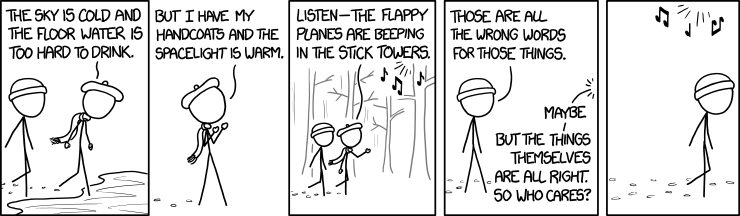
The above comic touches on an excellent point.  If the words we use are understandable, does it matter if they're not the correct words? Previously, I have written about lexical complexity noting that many factors affect how difficult we find a word.  The big factor that is played on here is context.  For example the term 'handcoats' in the second panel is understandable (as gloves) because we know from the first panel that 'the sky is cold'.  Handcoats is a word that you've probably never seen before, and out of context it would be difficult to get the meaning.  This highlights the importance of selecting words which fit the context of a sentence. If the correct context is chosen and a simple word fitting that context is used, then the understandability of a sentence will be dramatically increased.


Thursday, August 15, 2013

Orthography, Phonology and Nomenclature. Making sense of word relations!

In my role as computational linguist, I often find myself verging into areas of linguistics which I find nothing short of fascinating.  One such is the complex relation between English orthography (that is, how a word is written) and phonology (how it sounds).  In English, we have a 'deep orthography' meaning that a word doesn't necessarily sound the way it looks, leading to beautiful confusions such as:
weight vs. height

foot vs. food
or (my favourite):
cough vs. enough vs. plough vs. though. vs. through.
That's right, 5 distinct sounds from the letters 'ough'.

We also get the interesting phenomenon that one set of letters, with different pronunciations can have totally different meanings.  For example.
He decided to desert the army.
Camels live in the desert.

This is an example of heteronyms.  Heteronyms are different to homonyms which have the same pronounciation and spelling, but a different meaning. These are different again to heterographs, homophones and synonyms.  The table below defines the potential relations between words.  It is taken mostly from this venn diagram

Meaning Spelling Pronunciation
No Relation Different Different Different
Homophone Different - Same
Heterograph Different Different Same
Heteronym Different Same Different
Homonym Different Same Same
Different Spelling Same Different Same
Different Pronunciation Same Same Different
Synonym Same Different Different
Same Word Same Same Same

  • No relation: Two word words which are not related in any sense.
  • Homophones:  Words which sound the same, but have different meanings.  Further split into the following two categories:
  • Heterographs: Homophones with different spellings.  "There", "Their" and "They're" is a classic example.
  • Homonyms: Homophones with the same spelling.  E.g. "Right" (direction) vs. "Right" (entitlement).
  • Heteronyms: Words that are spelt the same but have a different sound and meaning. E.g. "desert" (leave) vs. "desert" (sahara) as in the above example.
  • Different Spelling: No technical word here, just words which mean and sound the same but are spelt differently. e.g. "Labor" (US spelling) vs. "Labour" (British Spelling).
  • Different Pronunciation: Again, no technical word, just two words which are written and mean the same, but sound different. E.g. 'the elephant' vs. 'the circus'.  ('the' takes a different sound in each).
  • Synonyms: Two words with the same meaning, but different pronunciations and written forms.  e.g. "friend" and "companion". Useful for lexical simplification as synonyms can be ranked according to their simplicity.
  • Same Word: No difference here whatsoever.
So there you have it.  I hope this is a helpful contribution to the often confusing world of word relation nomenclature.  I am certainly much more clear on the distinction between these terms as a result of writing this blog.